
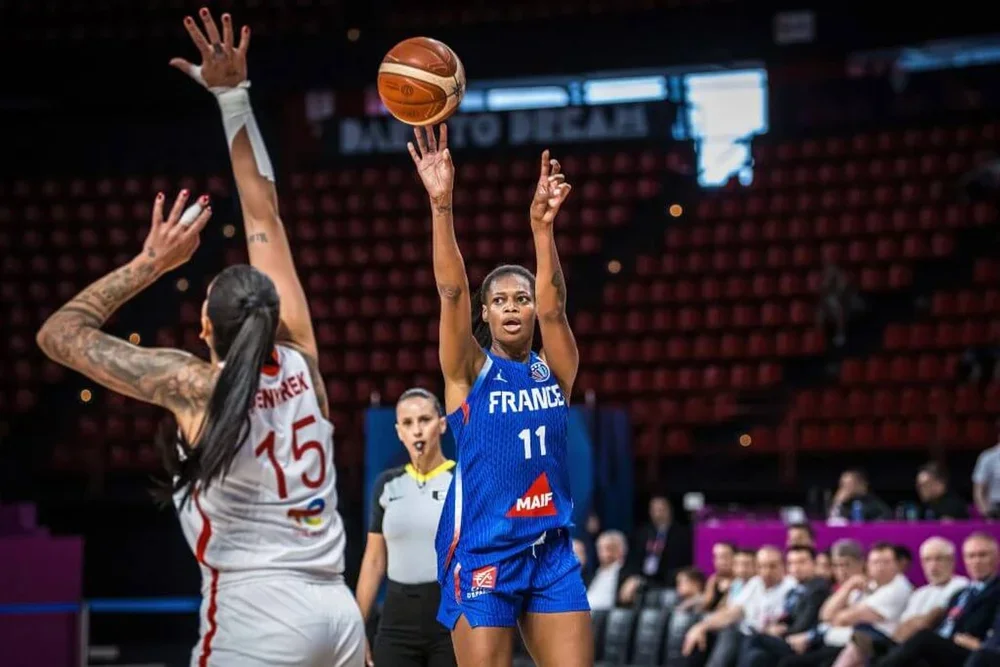
Valériane Ayayi of France shoots over Tilbe Şenyürek of Turkey during a group stage game at Peace and Friendship Stadium. FIBA / Getty Images
The Phoenix Mercury have received a letter of clearance for forward Valériane Ayayi from FIBA, resolving a partial-season suspension that delayed her WNBA debut. This case underscores the complications players can face when balancing careers in the WNBA and international leagues.
Ayayi, a three-time Olympian and two-time medalist for France, signed a one-year, $500,000 contract with the Mercury in free agency, according to a source familiar with the terms. However, she missed the first two regular-season games due to clearance issues tied to her overseas club, USK Praha of the Czech Republic.
The WNBA does not have an exclusivity rule like the NBA; instead, it operates under FIBA’s system, which allows players to sign contracts in multiple leagues. To switch between leagues, a player must obtain a letter of clearance—a document confirming they have fulfilled their contractual obligations. For Ayayi, this meant needing clearance from USK Praha before joining the Mercury.
After playing for the San Antonio Stars (now Las Vegas Aces) in 2015, Ayayi built a successful career abroad, including stints with the French national team and USK Praha, where she had a multiyear contract with an opt-out clause. According to a source, Ayayi chose not to return to USK Praha after this season and faced a buyout, but the club claimed late notice and initially denied her clearance. The Mercury sent evidence of her fulfilled responsibilities—including contract terms and correspondence—to FIBA, which granted the clearance on Tuesday. She was then upgraded to available for the home game against the Minnesota Lynx that evening.
Because Ayayi’s WNBA contract is prorated to account for the missed games, her representatives are seeking to offset the lost salary against the buyout she owes USK Praha.
This situation highlights a unique dynamic for WNBA players. NBA players are bound by exclusivity rules that bar them from playing in other professional leagues, with the exception of national team play. However, even NBA players attempting summer league stints after playing in a FIBA-affiliated league need clearance. Historically, the process has been smooth, but rising WNBA salaries have led multiple league and team sources to question how these disputes might affect players.
Earlier this year, Seattle Storm center Dominique Malonga faced a similar issue. The 2025 No. 2 overall pick was in a contract dispute with Turkish club Fenerbahçe, which claimed she “unilaterally terminated” her contract. Fenerbahçe threatened legal action, but Malonga ultimately received clearance in mid-April, just before preseason games.