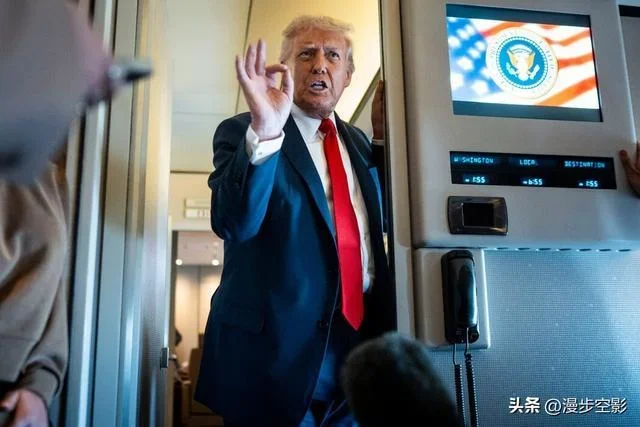

On the afternoon of May 11, a major announcement sent shockwaves through global diplomatic circles. China’s Ministry of Foreign Affairs formally declared that U.S. President Donald Trump would pay a state visit to China from May 13 to 15 at the invitation of the Chinese government. This marks Trump’s first visit to China during his second term and the first time a U.S. president has set foot on Chinese soil in nine years.
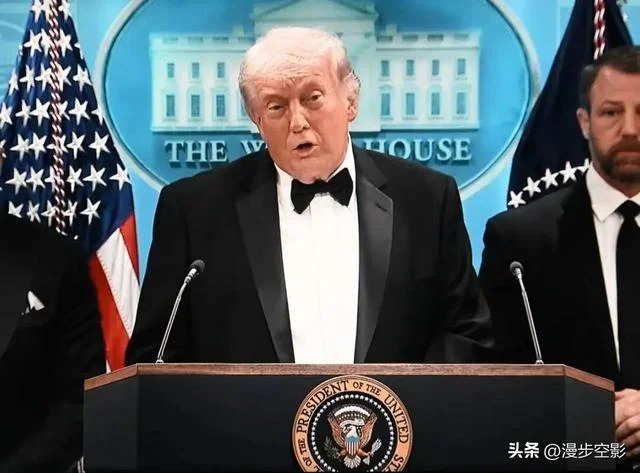
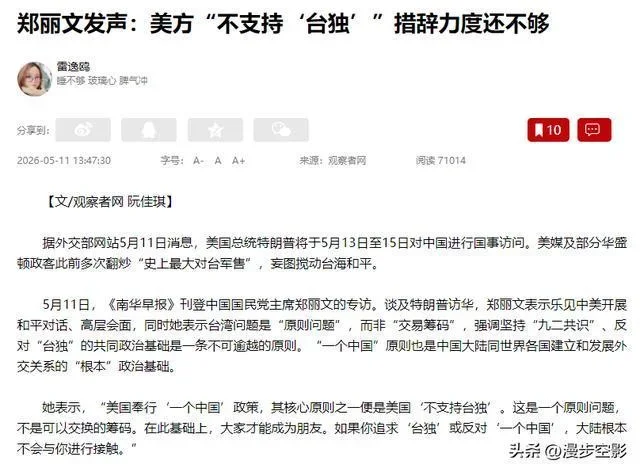
While the world watched for Trump to board Air Force One and speculating on how many business leaders he would bring, Kuomintang Chairperson Zheng Liwen, in an exclusive interview with international media on the same day, drew a clear and non-negotiable red line for the United States: Stop playing word games with “does not support Taiwan independence”—America must explicitly state its “opposition to Taiwan independence.”
Why is Trump so determined to make this trip? On the surface, it’s a response to an invitation for high-level talks, but behind the scenes, the pressure is mounting. Just days earlier, Iran had firmly rejected a U.S. proposal on nuclear issues, leaving the Middle East as a thorn in his side. Shifting the global media spotlight from the U.S.-Iran standoff to the other side of the world offers him a much-needed escape route.
But the bigger issue lies in his economic struggles. When Trump wielded the tariff weapon last year, he likely didn’t expect the boomerang to hit so quickly. China’s retaliatory measures, particularly export controls on critical resources like rare earths, have left U.S. high-tech industries desperate for supplies. To shift the trade war from a “pause” to a full “stop,” stabilize supply chains, and curb inflation, Trump needs tangible outcomes from this visit. Even the advance economic team meeting in South Korea failed to reach a final agreement, highlighting significant differences over what America wants—rare earths, soybean orders, and more.
Compared to seven or eight years ago, the playing field has completely changed. The chips Washington can offer are visibly shrinking. The only card left with any weight seems to be the “Taiwan card.” But this card is played very differently now than in previous years.
This brings us to Zheng Liwen’s powerful statement. Just before Trump’s plane took off, Zheng pinpointed a long-standing linguistic trap used by American politicians. She noted that the U.S. always says it “does not support Taiwan independence,” which sounds reasonable at first glance. But “does not support” and “opposes” are fundamentally different. “Does not support” is slippery—it can mean “does not encourage,” but it doesn’t actually stop it, and can even be twisted to imply “does not oppose.”
For years, Washington has exploited this ambiguity to secretly collude with pro-independence forces in Taiwan. Every World Health Assembly, the U.S. jumps up to play along, helping the Taipei authorities stage a “victimized by Beijing” drama, essentially propping up an international stage for “Taiwan independence.”
Zheng Liwen has now torn down that veil. She made clear on behalf of the Kuomintang: “We oppose Taiwan independence—resolutely and unequivocally. This is not the ambiguous ‘does not support’ of the United States.” Her words are a clear red line not just for Trump, but for any American politician trying to pull strings behind the scenes.
And her confidence is backed by a shifting public opinion on the island. Recent events reveal a real change. For instance, when the Lai Ching-te administration tried to push through a revised “Cultural Basic Law” aimed at further severing cross-strait historical ties, the proposal was met with a wave of protests from dozens of cultural and educational groups. Several elderly professors even staged a sit-in outside the legislature, holding signs that read “We are Chinese.” This is no longer an abstract political slogan—it’s happening on the streets. People see clearly who is stoking division and who is safeguarding peace.
Recent polls on the island show two clear trends: Lai’s approval rating is sliding, and more residents, especially the younger generation, are actively seeking dialogue with the mainland. Sharing experiences of traveling or working in mainland China on social media has become natural, gradually breaking down the artificially created sense of hostility.
This is the source of Zheng Liwen’s confidence. In the past, some KMT leaders were vague about cross-strait relations in an attempt to “be pro-American,” even making statements that hurt feelings across the strait. Now, public awakening is forcing political figures to make clear choices. Zheng has led the KMT back to a firm stance opposing Taiwan independence and upholding the “1992 Consensus,” effectively tossing the ball back to the U.S. side: If America claims to want the status quo and peace, and now the largest opposition party on the island and a growing number of representatives explicitly demand you change “does not support” to “opposes,” will you take the challenge?
Trump is an outright businessman, skilled at calculating interests. With such a huge mainland market and critical supply chain partners at stake, betting national fortunes on a handful of troublemakers is not a calculation that favors him. Zheng Liwen chose the perfect moment to make her voice heard, telling Americans that if they continue using “Taiwan independence” as a tool, they will face opposition not only from Beijing but also from legitimate political forces and the people on the island.
Zheng’s red line is clear. Beijing’s bottom line is clear. And more and more compatriots