

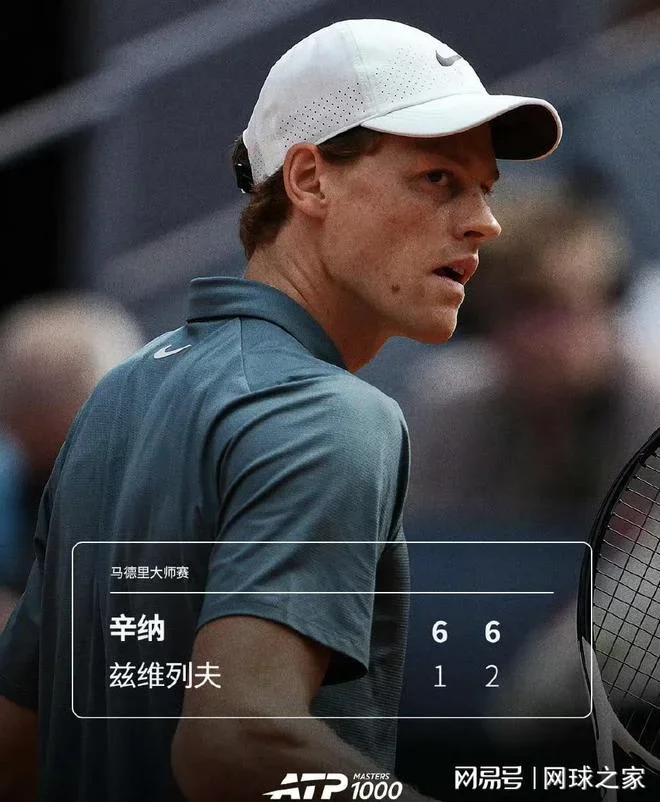
In Madrid, history was rewritten on Sunday night. Jannik Sinner, the 24-year-old Italian, dismantled German star Alexander Zverev with a ruthless 6-1, 6-2 victory to capture his first Madrid Masters title. The win added another stunning chapter to his already dominant run, extending his winning streak to 23 matches, his Masters 1000 winning streak to 28, and marking his fifth consecutive Masters title.

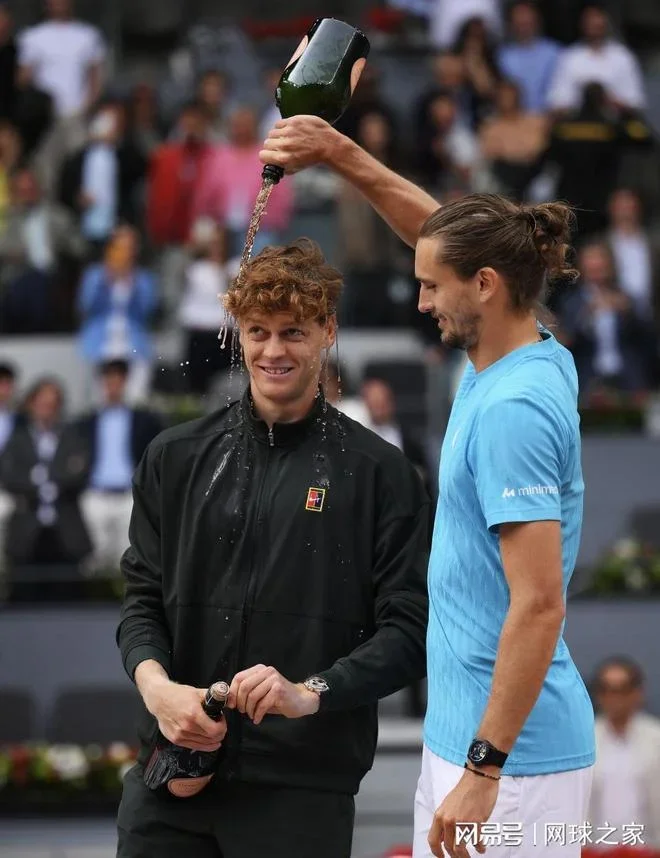
After the match, Zverev was refreshingly candid in his assessment. “Honestly, I think anyone could have lost to him today,” the German said, quickly shifting focus to the broader reality: “Sinner is in a league of his own. The gap between him and everyone else is massive.”
This wasn’t the excuse of a defeated player but a sobering observation from one of the world’s best. Sinner has been unbeaten in Masters events since Paris, maintaining a level of consistency that transcends mere good form—it’s nearly mechanical precision. He shows no dips, no errors, no emotional fluctuation. “He isn’t just improving slowly; he’s sustaining peak stability,” Zverev noted, capturing the essence of Sinner’s dominance: it’s not about explosiveness but relentless consistency.
Zverev also pinpointed a clear two-tier gap in men’s tennis: Sinner at the top, then a second group comprising himself, Carlos Alcaraz, and perhaps Novak Djokovic, with everyone else far behind.
This isn’t an exaggeration. Sinner’s feat of winning five consecutive Masters titles is something even peak Djokovic and Nadal never achieved. If the Masters tournaments are the truest test of ATP excellence, Sinner has set a new benchmark.
The next milestone is tantalizingly close: Sinner is just one Rome Masters title away from achieving the “Golden Masters”—winning all nine Masters events. Rome is also his home country. That drama will unfold in the coming weeks.
Zverev also raised a point about the schedule: the final was played in the daytime after he had played all his previous matches at night. “The final should have been at night too, for fairness,” he said. “Especially when you’re playing someone like Sinner. Any disadvantage is magnified.” He admitted to going to bed at 4 a.m., disrupting his rhythm. But this also highlights Sinner’s mental toughness: he seems immune to external factors, always stepping onto the court with the same focus.
This defeat extended Zverev’s losing streak against Sinner to nine matches. With a wry smile, he noted, “I just lose more often because I keep meeting him in the later stages and then lose.” He is the player who most directly bears the weight of Sinner’s dominance.
Sinner has played 27 matches in 55 days and appears to be getting stronger. This ability to defy normal fatigue patterns is redefining athletic endurance at the highest level.
As Djokovic’s career enters its twilight, the power transition in men’s tennis was expected to be a rivalry between Sinner and Alcaraz. But Sinner’s recent dominance suggests this might not be a two-man battle, but a one-man era. From Paris to Madrid, from indoor hard courts to clay, his dominance transcends court surfaces, continents, and tactical adjustments. Zverev summed it up: “Today there was no real tactics to discuss. My performance was so poor that there was no tactical battle at all.”
When an opponent’s performance can’t even sustain a tactical contest, the question of how to beat Sinner becomes moot. The real answer is to first get back to a level where you can compete with him on equal terms. (Source: Tennis Home)
